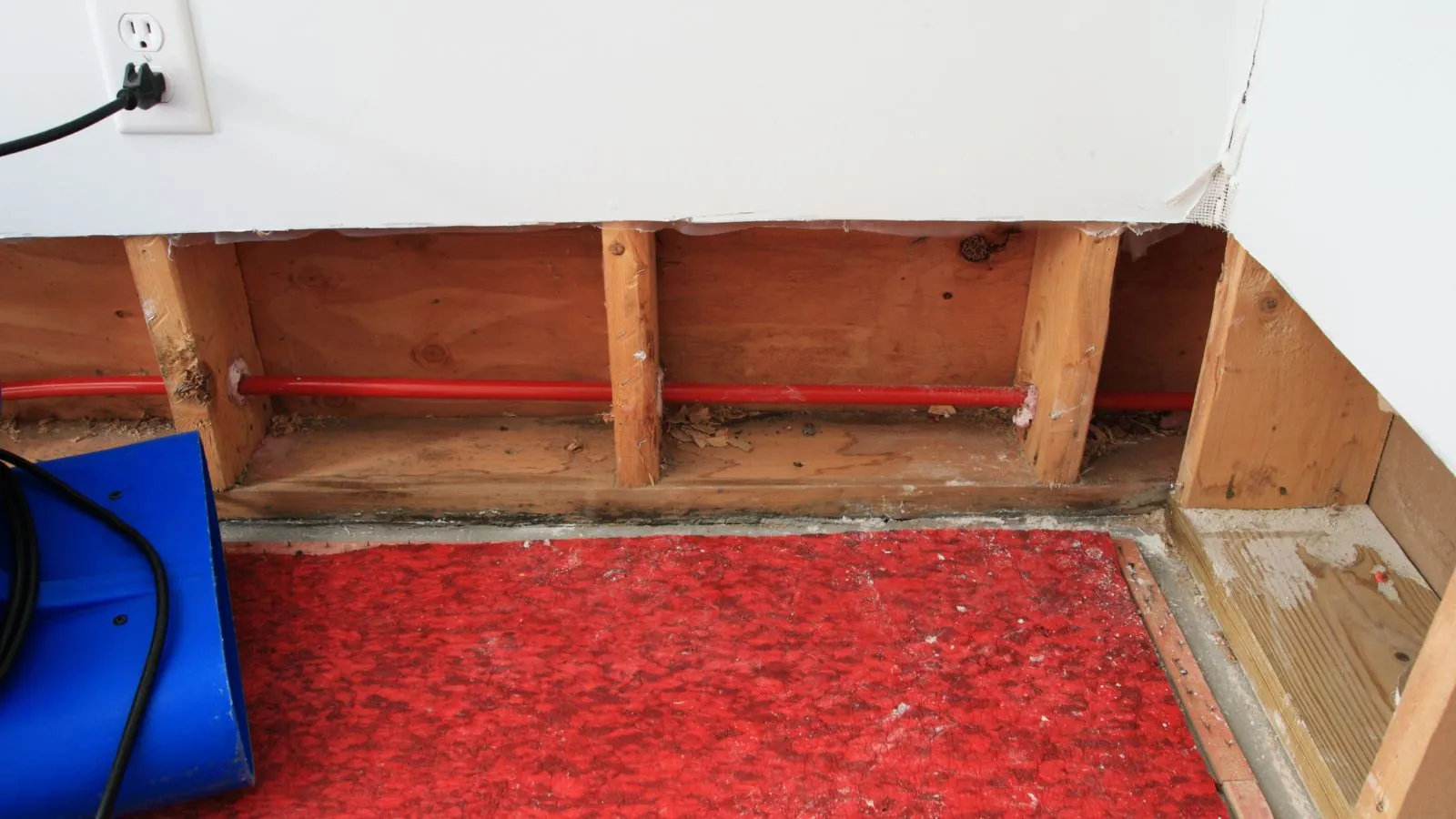
People ask how long water damage takes to dry because they want to know when life goes back to normal. The honest answer is a range. A clean-water leak caught early in a house with drywall and carpet is often dry in about three to five days. Dense materials and deep saturation can take much longer. This guide explains the pieces behind that range.
What drying actually is
Drying is a physical process. Water leaves a material as vapor, travels into the air and is removed by a dehumidifier. If any step is blocked, the whole job slows. Air movers speed the first step, dehumidifiers handle the last and sealed doors and windows keep new moist air out.
| Material | Typical drying behavior | What slows it |
|---|---|---|
| Carpet | Dries quickly on top | Wet pad underneath |
| Drywall | Days if it stays in place | Saturation and paint layers |
| Wood framing | Slow, often several days | Thickness and shaded cavities |
| Hardwood flooring | Slow and controlled | Cupping risk if rushed |
| Concrete | Slowest, can take much longer | Density and low airflow |
What changes the timeline
- How long the materials stayed wet before drying started.
- The water category. Contaminated water means removal, not drying.
- The amount of water and the area it reached.
- Humidity and temperature in the house during the dry-out.
- Whether wet materials were removed or left in place.
Speed matters more than anything on that list. EPA guidance on responding to water damage uses a 24 to 48 hour window to dry wet materials before mold has a chance to start, and treats it as a guideline rather than a guarantee. The water extraction page covers the first step, which is getting the bulk water out.
How crews know when it is dry
They compare. Moisture readings from the affected materials are compared with readings from similar unaffected materials in your own house, which sets the dry standard for that house. Readings are taken at the same points every day, and equipment is moved or removed as materials reach the standard. The method is described in detail on the structural drying page.
That is why a fixed number of days is not promised. A house in a damp August and a house in a dry January behave differently, and so do two rooms in the same house.
What you can do
- Keep doors and windows closed in the drying area, since open windows let in humid air.
- Do not move equipment or turn it off, since it is placed on purpose.
- Keep a log of the days equipment ran, for your insurer.
- Ask for the daily readings and the final reading that shows the dry standard.
- Wait for the dry signal before repairs begin.
Signs drying is going well
- Moisture readings drop each day and stay down.
- The air no longer feels heavy or damp.
- Surfaces feel cool and dry instead of clammy.
- The musty smell fades instead of returning.
- Windows stop fogging and the dehumidifier collects less water.
If the readings stall, something is wrong. There may be a hidden pocket of water, a source that has not been stopped or equipment placed where it cannot do its job. A good crew changes the plan when the numbers say so, instead of waiting for the calendar.
Why the guess on day one is only a guess
On the first visit, a crew can estimate a drying time from the size of the loss and the materials. The estimate is a starting point, not a promise. Hardwood, plaster, insulation and concrete each dry at their own pace, and the real answer comes from readings taken day after day until the structure reaches its normal level.
If you are planning around the dry-out, ask the crew for a daily update rather than a single end date. Knowing that tomorrow's readings decide whether equipment stays one more day lets you plan for work, school and sleep. Noise from air movers is real, so ask where the units will sit and how to quiet them at night.
Taylor, MI: why storms change the wait
After a large regional storm, drying companies are busy. The National Weather Service reported that 4 to 6 inches of rain fell over about four hours across Wayne, southern Oakland and Macomb counties on August 11, 2014, affecting roughly 75,000 homes and businesses. A wait of even a day matters when the 24 to 48 hour window is the guideline, so call early and describe your situation clearly.
Summer humidity in southeast Michigan makes dehumidifiers work harder, and winter heating can dry the air. In either season the readings, not the calendar, decide. Source used: EPA guidance on responding to water damage.
Drying time and where you live
The same principles hold for homes in Garden City, Southgate and the other towns we serve. See the pages for Southgate and Garden City for what makes each place different.
Questions people ask
How long does it take to dry a basement after water damage?
Concrete dries slowly, so a basement can take longer than a room with drywall and carpet. The crew uses readings on the slab and the framing to decide.
Can I speed up drying with my own fans?
Fans alone move air but do not remove moisture from it. Dehumidifiers matter as much as air movers.
Does the season in Taylor affect drying time?
Yes. Humid summers slow evaporation without dehumidifiers, and dry heated winter air speeds it up. Readings guide the schedule.
How do I know the dry-out is finished?
Ask for the final moisture readings and for how they compare with dry reference materials in your house.